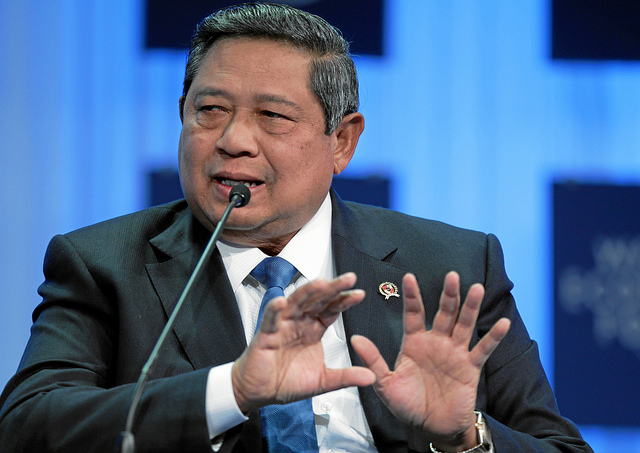
Indonesia’s President has vowed to dedicate the last three years of his administration to safeguarding his nation’s rainforests - a pledge that received broad support at a major conference in Jakarta.
Hosted by the Center for International Forestry Research (CIFOR), the conference provided a platform for 1,000 leaders of Indonesia’s government, business community and civil society, as well as foreign donors, to discuss the future of the forests, the third-largest tropical forest in the world.
“I will continue my work and dedicate the last three years of my term as President to deliver enduring results that will sustain and enhance the environment and forests of Indonesia,” Indonesian President Susilo Bambang Yudhoyono said at the conference. “If it weren’t for the benefits that our forests provide, then our way of life, our people, our economy, our environment and our society would be so much the poorer.”
“Our success in managing our forests will determine our future and the opportunities that will be available to our children.”
Indonesia is losing about 1.1 million hectares of its forests each year. Most of it is due to unsustainable logging that includes the conversion of forests to plantations for palm oil and the pulp and paper industry. It is also partly due to large-scale illegal logging, which is estimated to cost Indonesia about $4 billion annually.
“We must change the way we treat our forests so that they are conserved even as we drive hard to accelerate our economic growth,” the President said. “I do not want to later explain to my granddaughter Almira that we, in our time, could not save the forests and the people that depend on it. I do not want to tell her the sad news that tigers, rhinoceroses, and orangutans vanished like the dinosaurs.”
In his speech, the president reiterated a 2009 pledge to cut Indonesia’s greenhouse gas emissions by up to 41 percent from business-as-usual levels by 2020 – a vow only achievable if the forests are safeguarded.
Globally, deforestation accounts for up to 20 percent of greenhouse gas emissions. In Indonesia, however that figure is up to 85 percent, Yudhoyono said. This makes the country one of the highest emitters in the world.
Norway has committed up to US$1 billion to help Indonesia meet its emissions reduction target, and in May this year the Indonesian government issued a two-year moratorium on new forestry concessions.
“Norway is proud of the partnership with Indonesia,” Erik Solheim, Norway’s Minister for the Environment and International Development, said at the conference. “We strongly encourage other countries to support the work that President Yudhoyono and the government of Indonesia is doing to reduce greenhouse gas emissions. President Yudhoyono is now one of the foremost statesmen leading the international fight to combat climate change.”
It is predicted that up to US$30 billion could flow from developed to developing countries each year to help facilitate significant reductions in deforestation, and Indonesia could potentially claim a significant share of these funds through REDD+, a global mechanism for
Reducing
Emissions from
Deforestation and forest
Degradation, as well as the conservation and sustainable management of forests, and the enhancement of forest carbon stocks.
Indonesia is one of the countries with the most REDD+ demonstration activities in various stages of development, and Indonesia has been an early participant in various bilateral and multilateral initiatives to prepare for REDD+ implementation at the national level.
In addition to potential funding opportunities through REDD+ in coming years, Indonesia has a range of options available to reduce the pace of deforestation, while at the same time expanding agricultural production to guarantee food security targets and promote economic growth.
This includes focusing future agricultural development on so-called degraded land, rather than clearing rainforest to make way for plantations or developing carbon-rich peatland. The government could also support a push for agricultural intensification – increasing yields per hectare, which are currently relatively low.
“While there are some ‘win-win’ opportunities to reconcile forest management to meet both global and domestic objectives, there will also be some trade-offs that will require leadership from government, business, and civil society to determine the best way forward for Indonesia in a manner that is transparent and fair,” said Frances Seymour, CIFOR Director General.
As part of his push to safeguard the forests, President Yudhoyono called on Indonesia’s captains of industry to adopt more sustainable forests management practices.
“I call upon our business leaders, particularly those in the palm oil, pulp wood and mining sectors, to partner with us by enhancing the environmental sustainability of their operations,” the President said. “I ask you to join me in pledging to safeguard this national treasure for the sake of our children.”
The President’s pledge received widespread support from conference attendees.
“I am pleased to be here at the Forests Indonesia Conference because the UK recognizes the importance of climate change in Indonesia. We are pleased to be supporting the government of Indonesia’s work to meet its internationals climate change commitments,” said Jim Paice, UK Minister of State at the Department for Environment, Food and Rural Affairs.
##############
Transcript of the President’s speech.
SPEECH BY PRESIDENT
SUSILO BAMBANG YUDHOYONO
FORESTS INDONESIA CONFERENCE:
ALTERNATIVE FUTURES TO MEET DEMANDS FOR FOOD, FIBRE, FUEL AND REDD+
SEPTEMBER 27, 2011
SHANGRI-LA HOTEL, JAKARTA
Your Excellencies Minister Erik Solheim
[ei-rik sul-haim] of Norway, and Minister Jim Paice
[jim peis] of the United Kingdom,
Your Honour Mrs Frances Seymour
[fransis seimor], the Director General of CIFOR,
Excellencies Ministers and Ambassadors,
Chiefs of International Organizations,
Distinguished Guests,
Ladies and Gentlemen,
First of all, let
me begin by welcoming all of you to this important Conference.
It is indeed an honour and pleasure for me and my Government, to be part of this important meeting. The theme of this conference, “
Forest Indonesia: Alternative futures to meet the demands for food, fuel, fiber and REDD+” is very relevant and timely.
For Indonesia, like many other countries blessed with tropical forests, are facing the challenge of sustainably managing its vitally important forest resources.
Hence, let me congratulate the organizers, CIFOR and their partners, for bringing together—under one roof—forest stakeholders, from all over Indonesia and the world. We have among us government officials and representatives of NGOs, civil society as well as the business and academic communities.
We may have different backgrounds, but we all have known the pleasure of resting in the cool shade of a tree.
It would be nice if one day we could organize a conference like this in the open air, protected from the heat of the sun,
by the green crown of sturdy trees.
I am glad that this Conference discussion and its outcome will be shared online by audiences worldwide—including the forthcoming COP-17 in Durban, South Africa. This will be an excellent opportunity for us to stress on the importance to walk the talk, and
not just talk the talk.
On my part, I will continue my work and dedicate the last three years of my term as President, to deliver enduring results that will sustain and enhance the environment
and forests of Indonesia.
Distinguished Guests, Ladies and Gentlemen,
Exactly six months ago, in this same hotel, I spoke before the participants to the Business
for the Environment Conference,
or B4E conference. During that meeting I dared the business world to think innovatively—to create a balance between gaining economic benefits and ensuring the preservation and sustainability of the global environment.
The aim of today’s meeting, logically, is to build upon the discussions held last April and re-affirm Indonesia’s pioneering role in harnessing forestry to the global effort to address climate change.
Indeed, forests are so dear to my heart, and I am sure all of you also hold it close to your hearts. Forests are so precious because in the first place, if it were not for their air-filtering trees, we would all be breathing in polluted air and living in a much hotter world.
If it weren’t for the shelter and food that forests provide, we would have scarce if any biodiversity at all. And the wonders of the animal world such as the Sumatran tiger, the rhinoceros and the orangutan would have gone extinct a long time ago.
And most importantly, if it weren’t for the benefits that our forests provide, then our way of life, our people, our economy, our environment and our society would be so much poorer.
Hence, the core of my message today is that our success in managing our forests will determine our future
and the opportunities that will be available to our children.
And yet, our forests remain under tremendous pressure.
Globally we are facing the challenges of climate change and environmental degradation. Global warming increasingly threatens our livelihood and even our very survival. On top of that, because we are facing another global financial crisis, nations may lose vigour in meeting their environment-related commitments.
As a developing nation, we prioritize the promotion of growth and the eradication of poverty. But we will not achieve these goal by sacrificing our forests. We must attain both development and the management of our forests– simultaneously.
This is because forest management is tightly intertwined with the livelihood of our people, with our food security, with the availability of wood and fuel. It is also closely linked with climate change.
Therefore we need to take bold initiatives through close collaboration and partnership with all stakeholders.
We must change the way we treat our forests, so that they are conserved even as we drive hard to accelerate our economic growth. We must intensify our efforts to cut down emissions from land use, land use change and forestry exploitation. These factors account for up to 85 percent of Indonesia’s entire greenhouse gas emissions.
I do not want to later explain to my granddaughter Almira, that we, in our time, could
not save the forests and the people that depends on it. I do not want to tell her the sad news that tigers, rhinoceroses, and orangutans vanished like the dinosaurs.
And I am sure that none of you would want to deliver such grim news to your children and grandchildren. I am sure that you all want to see that those forests will still be there several decades from now—fascinating us with their beauty and the mysteries they hold. And still providing economic benefits while help stabilize the climate of planet Earth.
And I am also sure that you would like these forests to become our precious legacy for our children.
Ladies and Gentlemen,
Let me now bring up a few questions that are relevant to your discussions in this meeting.
First, at the global level, what would Indonesia’s sustainable forests management efforts mean?
Indonesia’s tropical forests are the third largest in the world – and they are central to our economy, environment and society. Our forests host roughly 12 percent of the world’s mammals, 16 percent of its reptiles and amphibians and 17 percent of all bird species. Over 10,000 species of trees have been recorded across the archipelago. Each year many new species are discovered in Indonesia. This biological gift is intertwined with the rich cultural diversity of Indonesia’s forest.
Forests are the lynchpin to our biodiversity. They are home to bees, bats, birds, insects and other pollinators of the crops we plant. They also help regulate the quality and availability of water for irrigation. Forests provide foods, including seeds, leaves, fruits, roots, gums, mushrooms, and habitat for animals.
Indonesia, home to the third largest tropical forests in the world, views itself as the custodian of these great green treasures; and I want to keep it that way. So we are gathered here to deal collectively with those challenges to our forests.
My next question is then,
why is sustainable forest management so important to Indonesia?
The first reason is food security. Indonesia’s 238 million citizens are under pressure of rising commodity prices. The Government of Indonesia is pursuing a programme to increase agricultural and forest productivity, particularly through the cultivation of critical and idle lands. In this regard, we have selected centers of rice production in several provinces throughout Indonesia. Indeed, the sustainability of forests is crucial to an abundant rice harvests.
Secondly, in the area of energy security, our forests are home to potential sources of energy such as micro-hydro, geo-thermal, and bio-energy. We are increasing the portion of alternative sources of energy in our energy-mix. Forest ecosystems offer competitive advantage by making possible the replacement of conventional fuels by renewable energy sources.
Thirdly, Indonesia is a major supplier of fiber. Indonesia’s land availability and the fast-growth of many tree species, supported by favorable tropical climate, have also increased the economic value of our forests.
Fourthly, forests make the terrain more resistant to landslides
that threaten many communities. They are vital to efforts at mitigating and adapting to climate change, the impact of which is now being felt all over our archipelago and the rest of the world.
Also, our mangrove forests—the largest in the world—can protect coastal communities from the devastation that can be inflicted by storms and tsunamis. Moreover, mangrove forests serve as nurseries to many fish species that are of great commercial importance—and also crucial to our food security.
Lastly, through our efforts at reducing CO2 emissions, Indonesia can make a significant positive impact on the climate situation. In this regard, although our peat swamp forests are the largest in the world, they have suffered degradation. That has greatly diminished their capacity to reduce CO2 emissions. Restoration is therefore essential.
Hence, it is clear that Indonesia’s forests are of immense value. They offer us a lot of opportunities and benefits.
We therefore need to go into partnership with all stakeholders to sustainably manage our forest resources.
Ladies and Gentlemen,
To ensure the sustainability of our forests while still meeting our development objectives, my Government has given priority to a set of policies and actions to safeguard our forests and ensure their sustainable management.
I made a pledge at the G-20 Summit in Pittsburgh that we in Indonesia will voluntarily reduce our greenhouse gas emissions by 26 percent from business-as-usual levels by 2020. Since then, my Government has carried out many initiatives.
In 2010, we signed a Letter of Intent with the Government of Norway to cut emissions by reducing deforestation and forest degradation. This is known as REDD Plus–a concept that was launched in Bali in 2007.
In May this year, I instituted a two-year moratorium on new licenses to exploit natural primary forest and all peat lands. About two weeks ago, I signed a Decree outlining more than 70 self-funded government programs. This is a demonstration of our commitment to reduce by 26 percent our projected emission in 2020 under a business as usual scenario.
These are groundbreaking steps, but they are not goals in themselves. They are simply measures that give us time and resources, to review and revise land use policy and practice. They also provide opportunity to develop a new sector in our economy—through ecosystem restoration concessions for carbon sequestration and emission reduction.
Apart from the moratorium, we have built indicative maps that are important to the implementation of REDD Plus, and to the formulation of wise policies related to forests. These maps will also facilitate the resolution of decades-long problems of land use and land tenure.
I have also signed a Decree to set up a Task Force for the establishment of a REDD+ agency as stated in the Letter of Intent. We are also developing a national strategy on REDD Plus. The strategy includes elements such as the establishment of REDD+ institutions, the formation of relevant financial mechanisms, monitoring and benefit-sharing. To this end, and to meet the REDD+ expected targets, global funding is necessary.
I am happy to inform you that there are now more than 40 REDD Plus pilot or demonstration projects across Indonesia. This makes us a pioneer in creative ways to address climate change. It also provides us with research insights that will enrich our discussions today, and at the forthcoming global negotiations in COP17 in Durban, South Africa.
Another initiative of ours is the Forest Eleven Forum that we launched four years ago, which has brought together major tropical forest countries. My Government has also pursued bilateral forestry cooperation with several countries.
In the light of international enthusiasm for sustainable forest management, our local stakeholders must also take an active role in this field. I call upon our business leaders, particularly those in the palm oil, pulp wood and mining sectors, to partner with us by enhancing the environmental sustainability of their operations.
Still another initiative is the provision of funding for small and medium enterprises run by forest-edge inhabitants, micro finance programmes for the rural poor and for women, and Local Development Projects (PNPM) for local villages.
At the grassroots level, we have also launched a massive campaign programme to plant one billion trees nation-wide annually
It is said that “an apple a day keeps the doctor away.” I would like to say: “A billion trees a year shield the world’s lungs from decay.”
Ladies and Gentlemen,
Despite our modest achievements, I am mindful that these efforts will only take us part of the way towards our emission reduction target.
A long journey still awaits us. We know we must do more, to address the primary sources of our greenhouse emissions, such as illegal logging, forest encroachment, forest and land fires, and peat land drainage. And indeed we are working hard and comprehensively to overcome these challenges.
At the same time, we are mainstreaming all these perspectives and commitments into a special development framework. Our endeavours to effectively protect the environment are reflected in a special 15-year Master Plan to accelerate and expand our economic development. This means that sustainable development is part and parcel of our efforts to boost Indonesia’s economy, so that it will become the 12th largest economy by 2025.
This meeting is of great value to Indonesia. It is a contribution to global efforts at protecting forests and to the advance of the climate change discourse.
I am especially pleased to see many business leaders here today because they bring decades of experience to the table, and help to shape the future of our nation’s forests. I encourage all of you to forge greater cooperation with international partners.
I ask you to join me in pledging to safeguard this national treasure, for the sake of our children.
As I mentioned earlier, Indonesia, as custodian of one the largest tropical forests of the world, will continue to maintain a pro-environment growth strategy.
The task before us today is to chart a sustainable future for our forests and meet our development objectives. This is not an easy task. But we will pay a much higher price if we do not take up the challenge. By working hard together, we can help guarantee the future of our forests. And the future of our children and grandchildren.
That future begins now.
I thank you
Wassalamu’alaikum Warahmatullahi Wabarakatuh
Source : http://blog.cifor.org